Sunday, 12 April 2015

Iphone 7Concept In Dubai

The next iPhone needs to be innovative and the main part is the screen ! New amazing concept shows the next generation of the iPhone device, the iPhone 7 with two screens.
The next iPhone will come with ( According to the concept):
– 4.9 inch Full HD Sapphire front display, wrap around screen
– The next operating system of Apple, iOS 9

– Capacitive home button and Touch ID sensor with 700 dpi pixel density
– NFC sensor and bluetooth 4.2
– Apple A9 chip quad-core 1.8 GHz with 2x faster GPU
– 13 MP rear camera, 2k@30fps, 1080p@120-480fps
– 2260 mAh battery with light indicator around the lightning connector


Wednesday, 1 April 2015

Google Unveils Asus Chromebit 'Computer on a Stick' With Chrome OS

Google and Taiwan's Asus are launching a "computer on a stick" which can plug into a display to turn it into a PC.

Google said in a blog post that the Asus Chromebit would be arriving mid-year with a low price tag.

"Smaller than a candy bar, the Chromebit is a full computer that will be available for less than $100," Google said.

"By simply plugging this device into any display, you can turn it into a computer. It's the perfect upgrade for an existing desktop and will be really useful for schools and businesses."

The statement offered no other details on the device, but Google also announced its lowest-cost Chromebook laptop computers at $149 in partnership with Chinese electronic groups Haier and Hisense.

With a display of 11.6 inches, the Haier computer is being sold through Amazon and the Hisense PC through Walmart.

Google has produced Chrome devices with other manufacturers including Acer, Lenovo, Dell and LG.

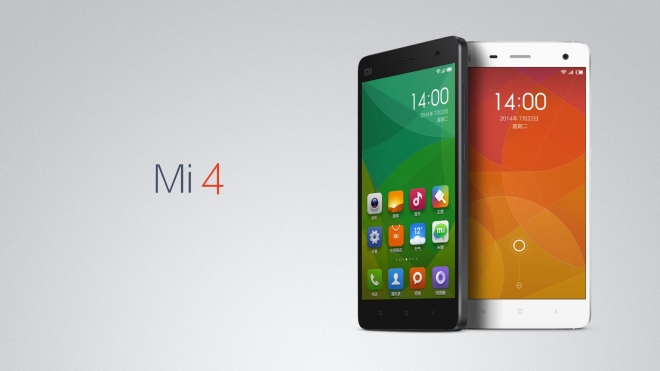
Xiaomi Mi 4 and Mi 4 'Lite' Get a Price Cut

Xiaomi at its Tuesday event in China revealed new devices on the occasion of its fifth anniversary, alongside announcing a price cut for the Mi 4.

The firm's 2014 flagship smartphone, theXiaomi Mi 4 will now retail at CNY 1,799 (approximately Rs. 18,000) for the 16GB variant down from the previous price tag of CNY 1,999 (approximately Rs. 20,000). According to GizmoChina, a 'lite' variant of the Xiaomi Mi 4 with 2GB of RAM instead of 3GB, will now retail at CNY 1,699 (approximately Rs. 17,000) - a CNY 100 price cut from the earlier price of CNY 1,799. Notably, both the Mi 4 variants will be available at reduced priced starting April 8.

Unfortunately, there is no clarity whether both the 64GB storage variant will also receive a similar price cut in China. The firm has also not detailed when the reduced prices will be made available in other countries.

To recall, Xiaomi took the wraps off its2014 flagship handset in July last year. It was launched at CNY 1999 while the 64GB model was priced at CNY 2499 (approximately Rs. 24,200).

Currently, Xiaomi India is selling the 16GB Xiaomi Mi 4 at Rs. 19,999, while the 64GB Mi 4 at Rs. 23,999 in the country via Flipkart.

For specifications, the Mi 4 (Review |Pictures) runs Android 4.4 KitKat with the company's MIUI 6 skin on top. It features a quad-core Qualcomm Snapdragon 801 processor clocked at 2.5GHz; 3GB of RAM; 5-inch full-HD display (1080x1920 pixels); 13-megapixel rear camera; an 8-megapixel front-facing camera, and a 3080mAh Li-ion battery.

Xiaomi on Tuesday unveiled a more affordable variant of the Redmi 2, the Redmi 2A. The Chinese company alongside also unveiled the Mi Note (Pink Edition).

The Xiaomi Redmi 2A has been launched at CNY 599 (approximately Rs. 6,000) and will be available at a special price of CNY 499 (approximately Rs. 5,000) on April 8 in China. The Xiaomi Mi Note (Pink Edition), on the other hand, has been priced at CNY 2,499 (approximately Rs. 25,000), which is slightly more than the original Mi Note that was launched at CNY 2,299 (roughly Rs. 23,000) for the 16GB model.

Apart from the new handsets, the Chinese company also launched three other products - the Mi Smart Scale, Mi Smart Power Strip, and Mi TV 2 55-inch model.

Intex Aqua M5 Available Online, Aqua Desire HD Listed on Company Site

Soon after introducing Aqua HD 5.0 andAqua Y2 affordable smartphones, Intex now appears set to launch another Aqua-series handset - the Aqua Desire HD (seen above) - which is now listed on the company's site. Unfortunately, there is no word on availability and pricing details of the Intex Aqua Desire HD.

Another budget Aqua-series smartphone, the Intex Aqua M5, is now available to buy via an e-commerce website, priced at Rs. 5,299. At the time of writing, the new Aqua M5 was not listed on the company's site.

The Intex Aqua Desire HD is an upgraded version of the Aqua Desire, which waslaunched in February. The dual-SIM (GSM+GSM) based Intex Aqua Desire HD runs Android 4.4.2 KitKat out-of-the-box and features a 5-inch (720x1280 pixels) HD IPS display. The smartphone is powered by a 1.4GHz octa-core MediaTek (MT6592M) processor coupled with 1GB of RAM.

It comes with 8GB of inbuilt storage, which is further expandable via microSD card (up to 32GB). It sports a 10-megapixel autofocus rear camera with an LED flash, while there is a secondary 5-megapixel front-facing camera also on board. On the connectivity front, the Intex Aqua Desire HD offers 3G, GPRS/ EDGE, Wi-Fi 802.11 b/g/n, GPS/ A-GPS, Micro-USB, and Bluetooth options.

The smartphone packs a 2000mAh battery, which according to the official listing is rated to deliver up to 5 hours of talk time and up to 210 hours of standby time. It measures 140x71.9x7.9mm, and will be available in Black and Blue colours.

The Intex Aqua M5, on the other hand, features a 5-inch FWVGA (480x854 pixels) display and dual-SIM support. It runs Android 4.4.2 KitKat and is powered by 1.3GHz quad-core MediaTek (MT6582V/X) processor coupled with 512MB of RAM. It comes with 4GB of inbuilt storage further expandable via microSD card (up to 32GB). There is an 8-megapixel rear camera with LED flash onboard apart from a 2-megapixel front camera. The handset supports Bluetooth, Wi-Fi, GPRS/ EDGE, 3G, and Micro-USB connectivity options. The smartphone is backed by a 2000mAh battery, which is rated to deliver up to 5 hours of talk time and up to 300 hours of standby time, according to the eBay Indialisting.

RHA T10i Review: A Premium In-Ear Experience

 rha_t10i_main_ndtv.jpgSome people prefer the comfort of over-the-ear headphones; others favour the convenience and portability of in-ears. It's simply a matter of personal taste. If you do choose to go the IEM way, you're unlikely to find a brand as dedicated to the art of producing quality in-ears as RHA.

Although relatively unknown in the mainstream market, RHA is a hit in enthusiast circles. This small Scottish IEM specialist has produced quality earphones for a while now. It's known for its detailed reproduction of audio and open sound. We've reviewed the top-of-the-line RHA T10i IEMs; read on to find out how they fared.

Design and Specifications
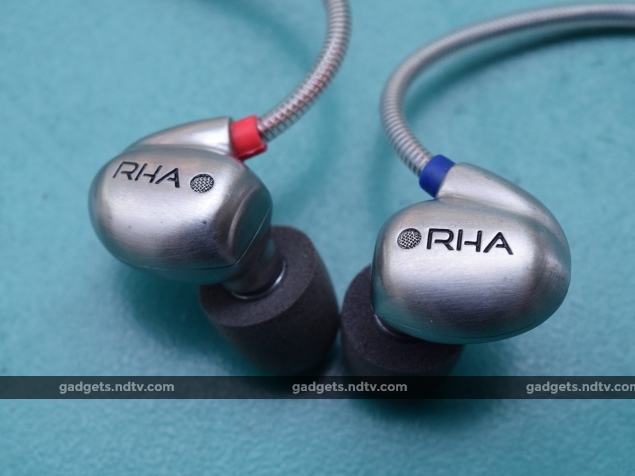
The RHA T10i is powered by the company's flagship 770.1 handmade dynamic drivers. It has a frequency range of 16-22,000Hz, an impedance of 16Ohms and a sensitivity of 100dB. The only out-of-the-ordinary specification is the weight; the T10i weighs a hefty 41g, because its casing is made entirely of injection-moulded steel.

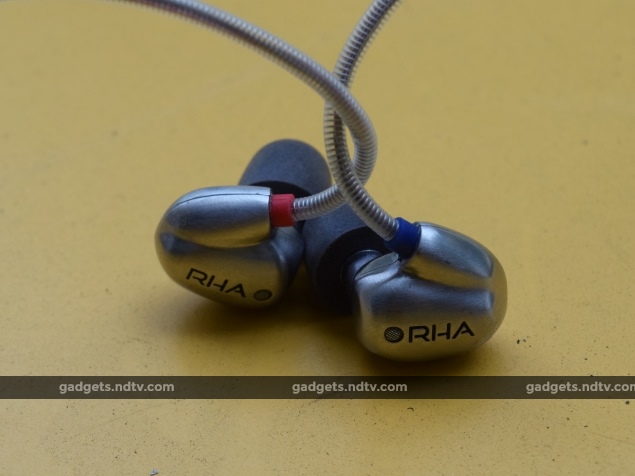
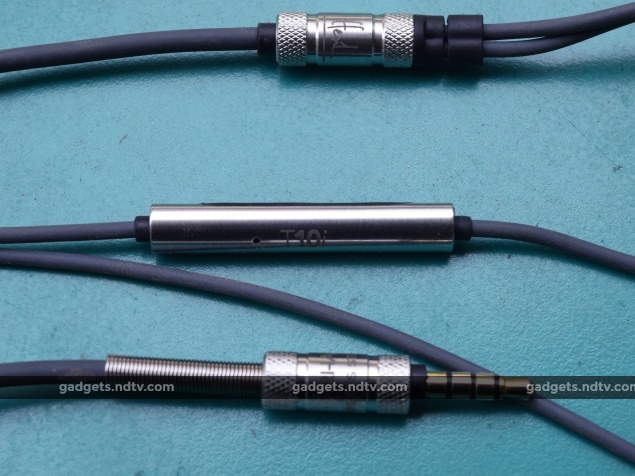
This is quite possibly the sturdiest and most well-built pair of in-ears we've had the pleasure of using. The solid steel casing looks like it's capable of withstanding all kinds of rough use (not that we tried), and makes a significant thud when it hits a hard surface. The same goes for the other steel parts, such as the 3.5mm plug, the in-line remote and the casing for the left-right splitter. The heavy build of the earphones means that they don't simply fit in your ears like any other pair. They have to be supported, and so they have flexible wires that hook them behind your ears. This is probably the only part of the design we don't like, but we got used to it soon enough so we won't go as far as to say it's a problem.

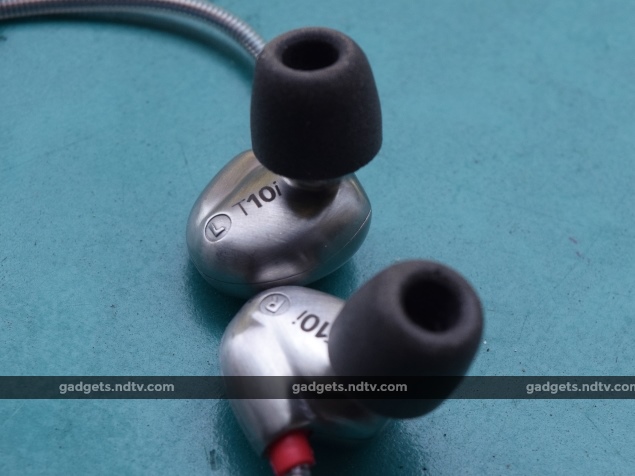
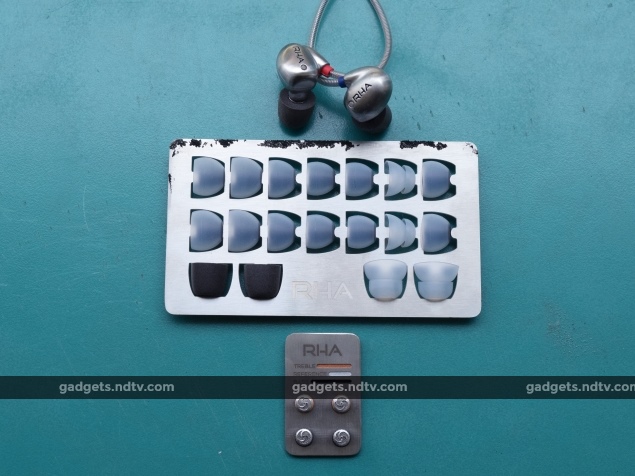
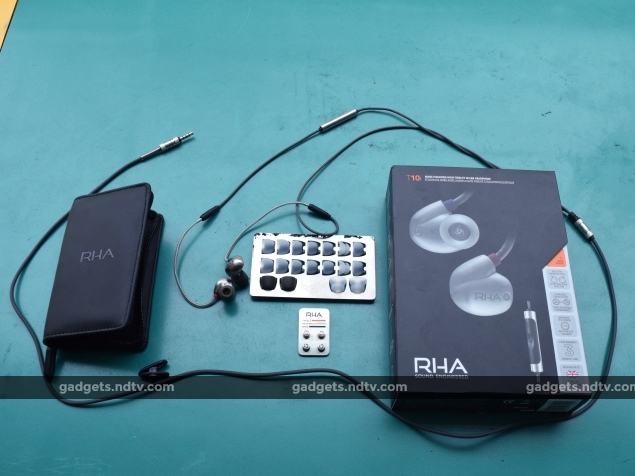
The most unique feature of the RHA T10i in-ears is the ability to swap out the tuning filters. After removing the ear-tip, it's possible to unscrew the filter and replace it with one of the others in the box. There are three sets of filters; reference, bass and treble. Each of these has the ability to modify the sonic signature slightly using the material within the filter, with up to 3dB boosts within the targeted frequency range. The reference filters definitely sounded better to us than the others, but it's an interesting way to tweak the sound to your listening requirements.

The box also includes a large carry pouch. It's far too big for the RHA T10i IEMs on their own, but the company probably assumes you'll be carrying the filters and ear-tips around with you as well. Even if you don't, it's nice to not have to stuff the earphones into a pouch that's only just large enough.

Fit and Comfort
As we've stated, the casing is too heavy to keep the earphones in your ears without support. The flexible ear-hooks aren't very comfortable, but they're unobtrusive and you get used to them soon enough. You still need to ensure that the ear tips are properly seated in your ears for optimal listening, and this might take some careful adjustment.

It helps that a total of ten pairs of different ear tips are provided. Two pairs of tips are foam, two are double-tipped rubber for a deep, snug fit, and the other six are ordinary rubber tips in varying sizes. We personally liked the larger of the foam tips and the double-tipped rubber ones, but fit is a subjective matter and it's up to you to decide what you want to use. Still, it's nice to have options, and this pair of IEMs comes with plenty. You're bound to find at least one pair of tips that fit your ear canals perfectly. Once properly inserted, you can wear the T10i in-ears for hours at a stretch without any discomfort.

Performance
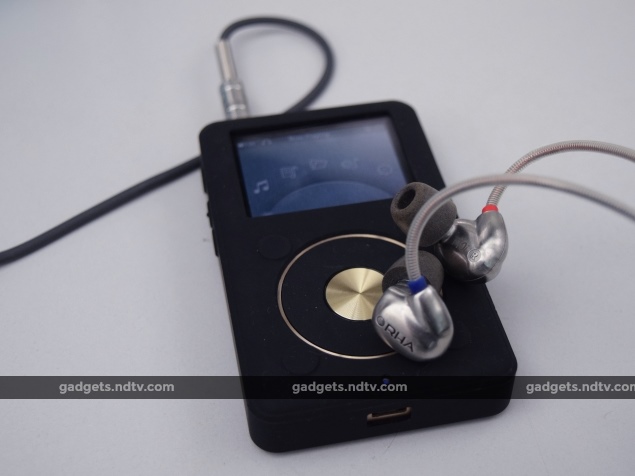
We used a PC, smartphone and Fiio X1 to drive the headphones during the review period. Our focus tracks were Michael Jackson's Remember The Time and Bonobo's Kiara in 16/44.1 FLAC, plus Gorillaz' Empire Ants and Clean Bandit's Rather Be in 320kbps MP3. This was to give a good mix of bass, mids and treble to test the RHA T10i in-ears with.

The first thing we noticed was that the T10i in-ears are treble heavy, as is evident in the early parts of Remember The Time. Michael Jackson's vocals also had a sense of sharpness to them. This gives them an open character and helps bring out the detail in the highs and mids. Lows are present and proper, but occasionally a bit too subtle. This take a lot of the excitement and drive out of these in-ears, but that is more than made up for by the immersive experience. Kiara showed that soundstaging and imaging are surprisingly good for a pair of in-ears, rivalling what you would expect from a quality pair of around-ears.

The two MP3 tracks in our focus playlist showcased the superior separation of instruments. The RHA T10i in-ears felt so realistic that we couldn't help but shut our eyes and imagine the tracks being played right in front of us. Empire Ants and Rather Be both feature excellent instrumentals and powerful vocals, and the T10i in-ears did a fantastic job of replicating all of them.

We felt that the excellent Fiio X1 got the best out of the RHA T10i IEMs and finally showed us just how capable these earphones are. We were a bit underwhelmed with the sound performance when playing tracks through a PC and smartphone. Although this isn't a fault of the T10i, it's important to point out that it requires top-notch equipment to run it to its full potential.

Verdict
The RHA T10i IEMs provide a beautifully immersive audio experience, and have the ability to get you lost in your music. Furthermore, the wide range of ear tips, the sturdy steel material and the unique concept of tuning filters makes these in-ears a truly attractive proposition for the price.

Although lacking in excitement and punch, the RHA T10i is to be commended for its superior sonic reproduction and dedication to openness. Even despite the seemingly high price tag, it is still worth auditioning if you like to immerse yourself in music and have decent equipment to drive it with.

Price (MRP): Rs. 14,999

Pros
1. Solid build quality.
2. Lots of ear tips for a good fit.
3. Tuning filters are a unique addition to the package.
4. Immersive, open sound; excellent across the frequency range.

Cons

1. Lacks excitement
2. Ear hooks are a bit uncomfortable

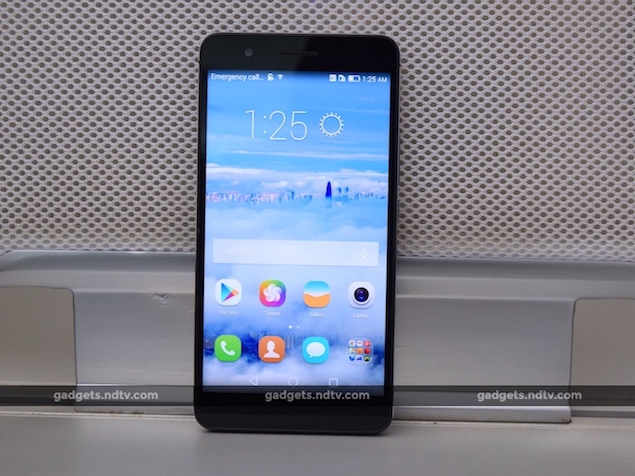
Honor 6 Plus Review: A Photographer's Delight

honor_6_plus_cover_ndtv.jpgAfter wowing quite a few critics with the Honor 6, Huawei's latest flagship, Honor 6 Plus, is making all the noise now. TheHonor 6 Plus' most important feature is the trio of 8-megapixel cameras - two on the rear and a front-facing one.

In its marketing spiel, Honor, a new sub-brand of Huawei, claims that the two parallel cameras on the rear can take better pictures than a DSLR camera. While we are taking those words with more than just a pinch of salt, we'd be very pleased if the Honor 6 Plus can take better photos than other Android smartphones in the same price range. Let's dive right in. 
Look and feel
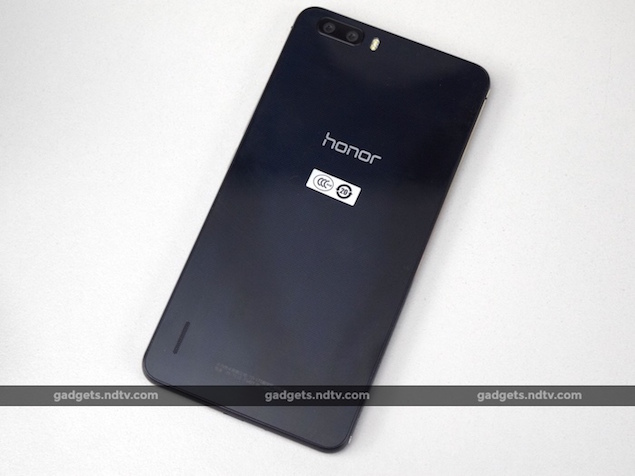
If Huawei's last flagship, Honor 6 (Review |Pictures), looked like the love child of theApple iPhone 4 and the Lava Iris Pro 30(Review | Pictures), the Honor 6 Plus looks like a fusion of the iPhone 4 and Sony Xperia Z3 (Review | Pictures). Taking cues from the iPhone 4's design, which had a glass back and metal edges, Huawei incorporates a similar design albeit on the much larger body of the Honor 6 Plus. A metal trim runs around the edges of the phone, and a sheet of glass is spread across the rear. In the same vein, the bottom of the phone has gentle curves that remind us of the Sony Xperia Z3.
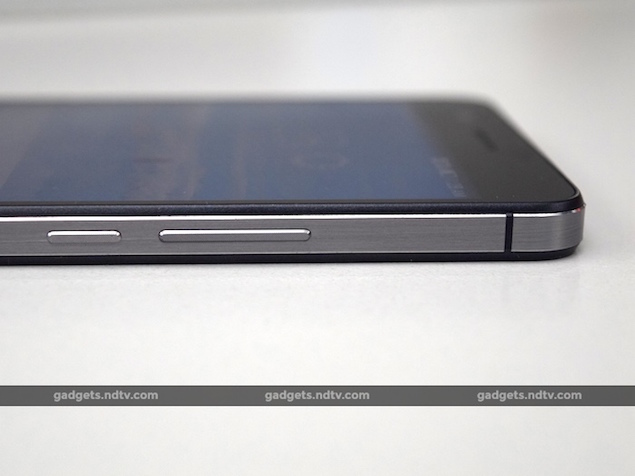
The Honor 6 Plus is fairly slim at 7.5mm but the weight of 165g is above average. However, we like the heft as it is distributed evenly across the body. Thanks to really slim bezels, holding the phone is not too difficult, although one-handed operation might take some effort. Despite being protected by Corning's Gorilla Glass 3 on the rear, the glass back is actually prone to scratches and could crack if the phone isn't handled with care. We'd recommend using a case with this phone.

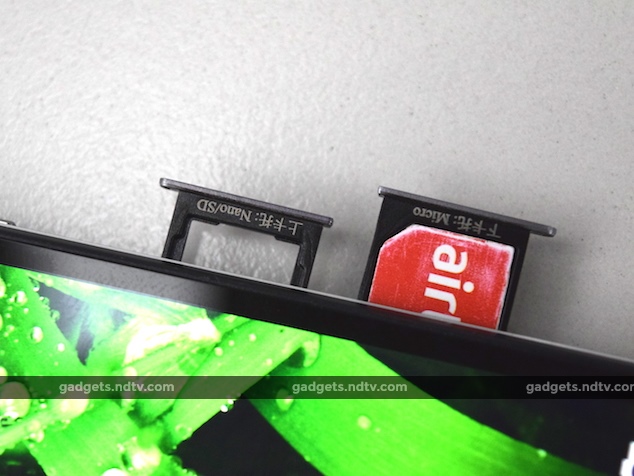
The volume rocker and power button reside on the right edge of the phone. The lack of a dedicated camera button on a phone that claims to take great images feels like a missed opportunity. Below the power button are two trays, one for the Micro-SIM card and another one that can accept either a Nano-SIM card or a microSD card. 

We received an early import from China for review, which simply did not recognise any Nano-SIM we inserted. Honor representatives told us that the Honor 6 Plus is marketed in India as a single-SIM device and units sold here will only work with one Micro-SIM. However, the company could not clarify whether the second tray will still have the same hybrid design and whether the markings explicitly describing it as a Nano-SIM tray will be visible as they are on our review sample. If this is not changed on units hitting the market here, customers are likely to be confused and frustrated. All other specifications of our test unit were consistent with what Honor is advertising in India.
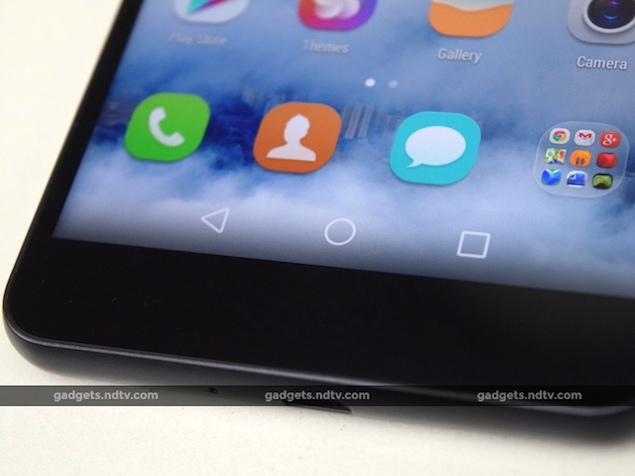
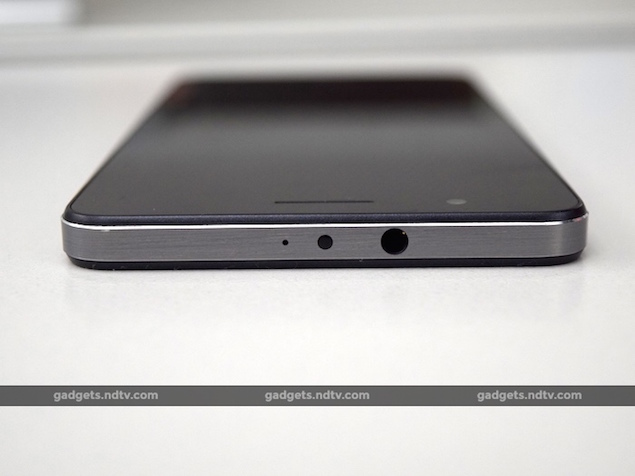
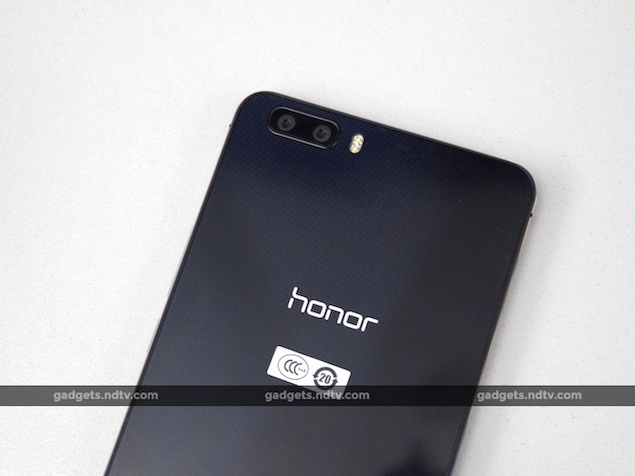
A Micro-USB port sits on the bottom of the phone along with a microphone for calls. The 3.5mm jack, infrared port and another microphone are on the top. The rear houses the dual cameras, flash and the speaker. The word 'honor' is also imprinted on the rear. The front is dominated by the display and Huawei has placed the earpiece, secondary camera, and notification LED above it. There are three onscreen buttons - Recents, Home, and Back - for navigating through the Android operating system. A nice trick is that Huawei allows users to adjust this navigation bar according their preference.

The 5.5-inch IPS LCD has a resolution of 1080x1920, which translates to a pixel density of approximately 401ppi. The display is rich in colours and is very vibrant too, but it doesn't get too bright. Thankfully, this doesn't really affect sunlight legibility. The viewing angles are pretty decent too.
Specifications and software
The Honor 6 Plus uses a homegrown Hisilicon Kirin 925 octa-core SoC. The Kirin 925 uses ARM's big.LITTLE architecture with four Cortex A7 cores clocked at 1.3GHz and another four 1.8GHz Cortex A15 cores. The integrated GPU is a Mali-T628 MP4. There is an ample 3GB of RAM and 32GB of internal storage space on the Honor 6 Plus. The storage space can be expanded up to 128GB using a microSD card. 
The Honor 6 Plus supports Indian LTE networks on the 2300MHz and 1800MHz frequency bands. Other connectivity options include Bluetooth v4.0, Wi-Fi a/b/g/n, Wi-Fi Direct and NFC. The phone has two 8-megapixel cameras on the rear which can be used in tandem to shoot a composite 13-megapixel image. Moreover, using two cameras Honor claims that more light can be captured for a better shot. We'll check this out in the camera section of our review. Completing the trio is a front-facing 8-megapixel camera. There is a 3600mAh battery under the hood which provides the juice. 
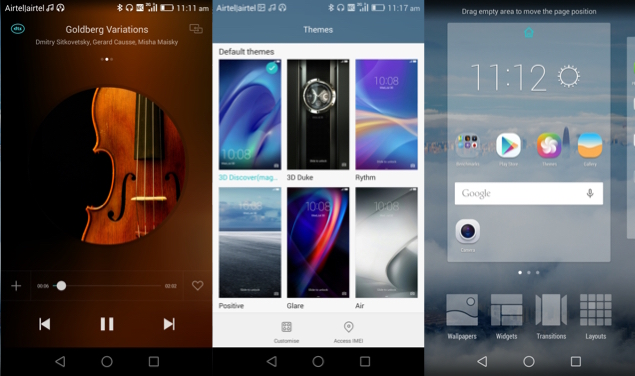
The phone runs Android 4.4.4 with the latest Emotion UI (EMUI) skin on top. Honor has cleaned up EMUI to include flat icons and a pastel colour palette, which is pleasing to the eye. The UI is also very nimble now. The magazine-style lockscreen, which we first saw in the Honor 6, is still present. There are a few software tweaks which are pretty useful. We particularly liked the Ultra battery mode, which only enables calls, messages and contacts. There is also an option to use One-hand UI mode that shrinks the keyboard, navigation bar and the phone UI to one corner of the screen. EMUI also includes a Suspend button which sticks to the edges of the screen and replicates the navigation bar on a half-wheel. We are unsure if the Suspend button will really be useful for many people. On the other hand, Huawei bundles useful third-party apps such as Kingsoft Office, Facebook and Twitter.

Camera
The parallel camera setup does actually result in good low-light images. We can safely say that the Honor 6 Plus is the best Android phone to get in this price range if you enjoy any sort of low-light photography. In fact, the Super night mode in the camera app opens up the aperture and reduces the shutter speed drastically. It works best if you can find a way to keep the camera stable or on a tripod. However, the only problem with this mode is that elements of the image merge into each other and this creates a watercolour like effect.

(Click for full size)

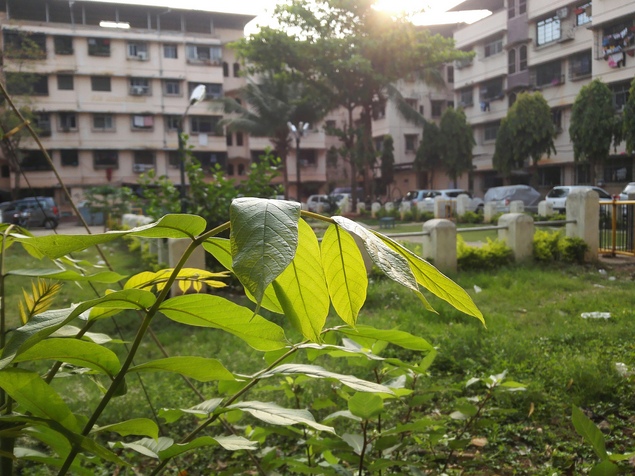
In daylight shots, we saw that the camera can reproduce natural colours. We'd go as far as to say it is almost as good as the Microsoft Lumia 830's camera. In comparison with the Lumia 830, details are not as well-defined and there is some barrel distortion. The underlying software processing the images however manages to keep noise at bare minimum levels. You can choose to save larger 13-megapixel images, which are created by the phone using both rear cameras in tandem.
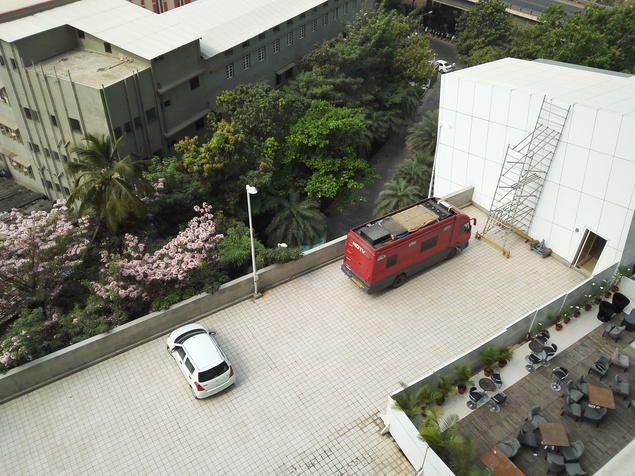
The dual cameras can also be used together in the Wide aperture mode, which is something similar to what we've seen in the Lytro range of cameras or HTC One (M8)'s duo camera setup. In this mode, the large f/0.95 aperture of the lens comes into play and this can be adjusted all the way down to f/16. This works best when the subject and the background are well-defined. You can create a nice bokeh effect while taking shots, or recompose them after they have been captured. We preferred the latter approach since it gave us more control over the areas we would like to focus on. 
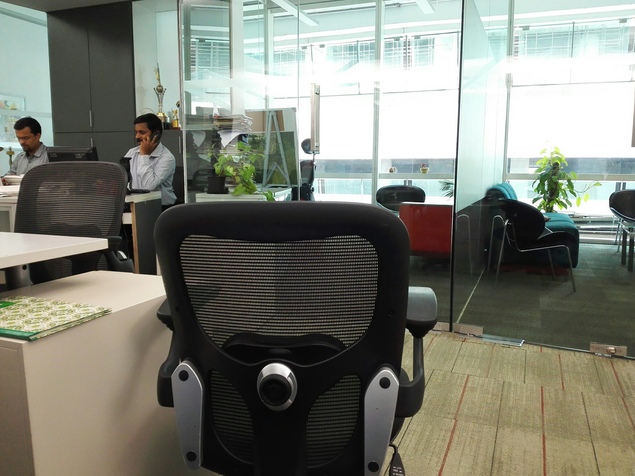
(Click for full size)

We captured a 1080p video but the lack of optical image stabilisation meant that it was quite shaky. Also, our test video had some areas that were clearly underexposed. The 8-megapixel front camera takes some very good selfies but it had a problem with handling whites and tended to overexpose them. That said, our test shots were well detailed and the beauty mode can help fix blemishes. 
(Click for full size)

Performance
The Honor 6 Plus was a delight to use during the course of testing period because it worked without any hiccups or stutter. In fact, the Kirin 925 processor is tuned really well to work with EMUI which explains the smooth frame rate of page turn animations. Games like Asphalt 8 and Dead Trigger 2 ran smoothly and we didn't encounter any frame drops.

The phone scored a healthy 44,698 points in AnTuTu but the Quadrant score was below our expectations; the Honor 6 Plus managed to log only 11,922 in that test. The phone scored 14,110 points in 3DMark Ice Storm Unlimited and 17fps in GFXbench - both better than average scores. 
All our test videos, which included a heavily encoded 40Mbps sample, played without skipping frames or artefacting. The loudspeaker is one of the low points of the phone as it doesn't get loud enough and sounds tinny too. Similarly, the sound quality through headphones isn't too good either. There is a DTS mode and it only amplifies the sound, which is still not very loud without any change to the quality. We had a similar problem with the Honor 6 as well. Huawei needs to sort this problem out soon.

The audio quality in calls is good but we faced call drops on more than one occasion in areas where there was low signal strength. The phone lasted a good 11 hours and 26 minutes in our video loop battery test. This is a pretty good figure and one should be able extract at least a day and a half on moderate use out of the 3600mAh battery.
Verdict
We had a lot of fun using the Honor 6 Plus and peg it to be one of the better Android phones we've reviewed in the recent past. The exceptional performance of its dual rear cameras is an added advantage since not many Android phones in the same price range can achieve that.

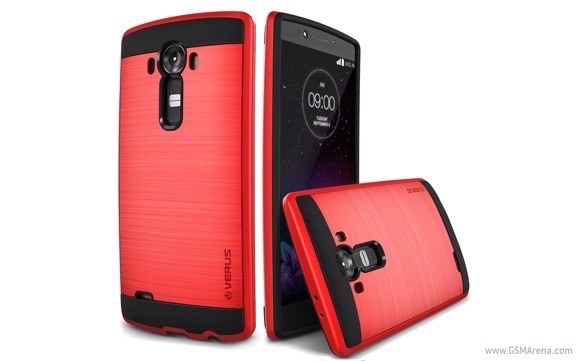
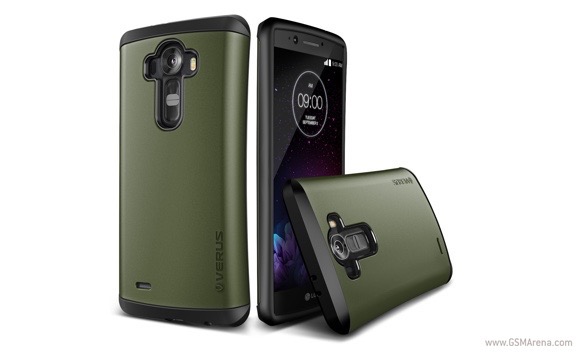
Images of LG G4 in a protective case make the rounds

Images of the yet to be announced LG G4wearing a protective case made the rounds online, courtesy of the manufacturer of mobile accessories Verus. The successor of LG G3 will make its official debut next month, on April 28.

The case maker’s images appear to fall in line with the recently leaked early press renders of LG G4. They showcase a slightly curved display, coupled with controls layout similar to the one found in LG G3. The actual cases are set to become available on April 30 - two days after the launch of LG G4.

Rumored specifications of LG G4 include Qualcomm Snapdragon 808 with hexa-core CPU, 3GB of RAM, 32GB of storage, and 5.5” QHD display. There will be a 16MP main camera and 8MP front-facing snapper on board.

Source

Huawei’s mobile division wraps up 2014 with record revenue

Huawei released its audited annual report for 2014. The Chinese tech giant posted record revenue of $46.5 billion and net profit of $4.5 billion - up 20.6% and 32.7% respectively from the previous year.

The company’s Consumer Business Group which designs and manufactures smartphones and tablets saw its annual revenue grow by almost a third (32.6%) from 2013 to $12 billion. Healthy demand for the company’s smartphones and tablets drove the revenue bump.

The manufacturer invested $6.6 billion for research and development in 2014. That is 14.2% of Huawei’s revenue and 29.4% more than in 2013. Overall, the company has spent a whopping $30.7 billion on R&D over the past decade.

Huawei will likely continue growing throughout 2015. The company will launch its next flagship smartphone, the Huawei P8 on April 15.

Source

Xiaomi gives the Mi4 a price reduction in China

Xiaomi gave the Mi4 smartphone a price reduction in China. From April 8 onwards, the popular high-end smartphone will cost 1,799 Yuan (about $290), down from 1,999 Yuan (about $322).

A slightly lower end variant of the Xiaomi Mi4 with 2GB of RAM will cost 1,699 Yuan (about $274) in China. Previously, it was priced at 1,799 Yuan.

Considering its new price tag, the Xiaomi Mi4 surely offers a lot of smartphone for the money. The smartphone features Qualcomm Snapdragon 801 chipset, 5” 1080p display, 13MP main camera, and 8MP front-facing unit.

The new Xiaomi Mi4 pricing falls in line with the company's plans to boost its sales. The company plans to sell 100 million smartphonesthis year.

Via

Rumored Qualcomm Snapdragon 815 chipset doesn't exist

A couple of months ago we first heard a rumor talking about a purported Snapdragon 815 chipset from Qualcomm. This was supposed to carry ARM's big.LITTLE architecture, with an octa-core CPU, Adreno 450 GPU, LPDDR4 memory support, and a MDM9x55 built-in modem with Cat.10 LTE capabilities. The Snapdragon 815 was apparently going to be made using a 20nm process.

There's only one problem with all of the above, it turns out. It's all fiction. At least this is what Qualcomm itself says, through the voice of Jon Carvill, the company's Senior Director of Public Relations.

He spoke to Fudzilla and clearly stated that Qualcomm has no plans for a Snapdragon 815 SoC. In fact, the company's next top of the line mobile offering will be the Snapdragon 820, the successor to the Snapdragon 810.

The Snapdragon 820 is expected to sample in the latter part of this year, while devices powered by it should be out either at the end of 2015 or at the beginning of 2016 - that is, if there won't be any delays. In the mobile chipset industry delays are nothing out of the ordinary, though, keep that in mind.

The Snapdragon 820 will be built using a FinFET process, and it will be the first 64-bit SoC to come with a Qualcomm custom core, named Kyro. This will be based on ARMv8, but will be designed by Qualcomm. For comparison, note that the current king of Qualcomm chipsets, the Snapdragon 810, uses ARM-designed cores in a big.LITTLE configuration.

Source

Gold 64GB Galaxy S6 and S6 edge now on pre-order at T-Mobile

Both the Samsung Galaxy S6 and the Galaxy S6 edge are now available to pre-order from T-Mobile USA in gold, with 64GB of built-in storage space.

T-Mobile started taking pre-orders for Samsung's latest top of the line smartphones on March 27, but up until today the magenta carrier only offered up the black and white color versions for them.

The gold-colored handsets have been marked as "coming soon" during this period, but now they're finally up for grabs as well.

If you pre-order a gold Galaxy S6 or S6 edge from Samsung today, you can expect delivery before April 10, which is the official release date for both models in the US. This is the same for all colors of the devices, with T-Mobile trying to send every pre-ordered unit out as soon as possible, maybe even before the launch day.

For now the gold S6 and S6 edge are only offered with 64GB of storage, though we assume the entry-level 32GB iterations will soon be up for pre-order too, along with those coming with 128GB.

As for pricing, for a 64GB Galaxy S6 you need to put down $99.99, then followed by 24 monthly payments of $27.50. For the S6 edge you put down $99.99, followed by 24 monthly installments of $31.66.

Source 1 • Source 2 | Via 1 • Via 2

Samsung Galaxy Alpha will get Lollipop alongside the Note II

Samsung's websites for Finland and Denmark are giving us some interesting information about which devices the company plans to bring Android Lollipop to next.

As you may know, the Galaxy Note 4Galaxy Note EdgeGalaxy Note 3Galaxy S5Galaxy S5 Active, and Galaxy S4 have already received the tasty treat, at least in certain regions. But what's next for Samsung?

Well, it turns out the Korean company also plans to bring Lollipop to the Galaxy Note II,Galaxy Alpha, and Galaxy S5 Mini.

We've already heard about Lollipop making it to the Galaxy S5 Mini, as well as the Galaxy Note II- but another official confirmation is good to have. This also marks the first time Samsung has said anything conclusive about the Galaxy Alpha with regard to the Lollipop update, so it's good news for owners of that model too.

Rollouts for the S5 Mini, Alpha, and Note II are apparently scheduled to happen "later in 2015", and unfortunately no more specific details are available right now. Previously, Samsung's French arm said Q2 was the time frame for the Galaxy S5 Mini's Lollipop update, so maybe that's true for all three handsets. If so, you're looking at a maximum of three months of waiting, from this point on, for the new software.

As for the Galaxy Note II, it's nice to see Samsung still care about a device that's two and a half years old.